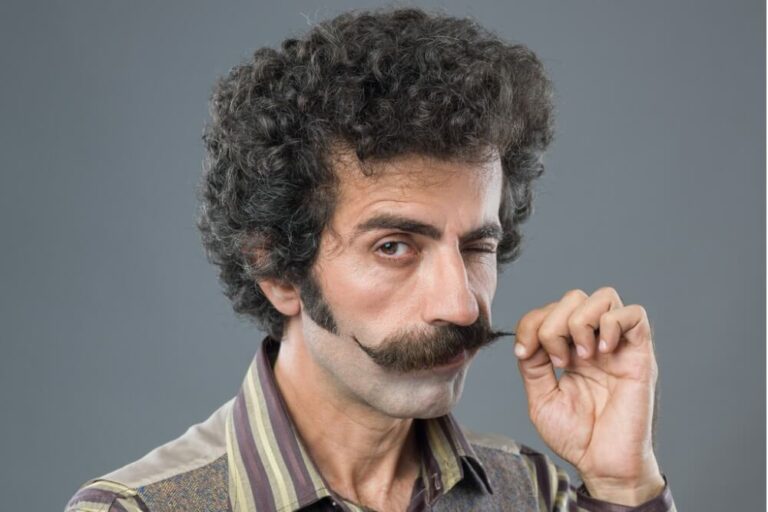

At a glance
- The routine: clean, dry, comb, trim if needed, then shape
- Time: depends on the style and whether a trim is needed
- The kit: comb and suitable scissors or guarded trimmer; wax is optional
Styling starts with the mustache you have and the shape you want. Simple styles may need only a comb and occasional trim; curled styles usually take more shaping.
Here is a step-by-step grooming routine, followed by 14 photographed mustache styles and combinations.
Find what suits you: browse all beard styles, mustache styles, or the trimming guide.
How to Style Your Mustache

Before we get into specific mustache styles, let’s cover the basics of styling a mustache the right way.
Preparation
Styling a mustache is about more than just showing off your growth and trimming skills. You need to set yourself up properly before a single clipper or scissor touches your face. Here is what that looks like:
1. Research Mustache Styles:
Explore mustache styles that work with your facial hair and the upkeep you want. The following names offer starting points for research; the photographed examples later in this guide cover 14 styles and combinations.
Classic Mustache Styles:
Unique and Bold Mustache Styles:
Trendy and Modern Mustache Styles:
- Walrus Mustache
- Pyramid
- Anchor Beard with Mustache
- Beardstache
Historical Mustache Styles
- Imperial
- English Mustache
- The Hungarian
- Toothbrush Mustache
Additional Mustache Styles:
- Lampshade
- Painter’s Brush Mustache
- Zorro Mustache
- Cop Stache
2. Gather Necessary Tools and Products:
Make sure you have everything you need before you start. Depending on your chosen mustache style, that kit should include:
- A mustache comb to keep your facial hair looking neat and tidy on the go.
- Sharp, purpose-built scissors for precision trimming and shaping.
- A quality beard trimmer with adjustable clipper guards to maintain the length and shape of your mustache.
- Mustache wax if your chosen style needs hold, especially curled or swept-out ends.
- An optional conditioner or moisturizer suited to your skin and facial hair.
- A gentle beard cleanser or specialized beard wash to keep your mustache clean and free of debris, so it looks and feels fresh all day.
3. Dedicate a Well-Lit Space for Grooming:
Choose a space with solid lighting, preferably a bathroom with a large mirror, so you can clearly see what you are doing while styling your mustache.
Step-by-Step Styling Process
Now that you know the different mustache styles and the tools you will need, it is time to walk through the step-by-step process of styling your mustache.
Step 1: Clean and Condition Your Mustache
- Wet your mustache with warm water.
- Apply a gentle beard cleanser or beard wash to your mustache and work it into a lather.
- Gently massage the cleanser into your mustache, making sure it reaches the skin beneath the hair.
- Rinse thoroughly with warm water to remove all residue.
- Pat your mustache dry with a clean towel. Avoid rubbing to prevent irritation and beard frizz.
- Use a suitable conditioner or moisturizer if needed. Let the mustache dry and avoid excess oil before applying wax, since oily hair can reduce hold.
Step 2: Comb Your Mustache
- Use a small comb gently, with its teeth reaching through the hair.
- Comb downward to check a natural lip line, or outward from the center for a swept-out style. Preserve longer hairs needed for curls.
- Gently comb through any tangles to avoid breaking or pulling hairs.
- Repeat on the other side of your mustache.
Step 3: Assess and Plan Your Trim
- Examine your mustache in the mirror, identifying any uneven areas or stray hairs.
- Visualize your desired mustache style and shape, noting how it aligns with your current growth pattern.
- Decide on the length and shape you want to achieve during the trimming process.
Step 4: Trim Your Mustache
- Stand in front of a well-lit mirror for optimal visibility.
- Start with dry hair and remove a little at a time, checking both sides frequently.
- For a natural mustache, tidy the lip edge to the length you want. For a handlebar, preserve the longer hairs that need to sweep sideways rather than cutting all of them at the lip.
- Trim any strays that extend beyond your desired mustache outline.
- Step back and assess your mustache trim, making any final adjustments as needed.
Step 5: Apply Wax if Needed
- Start with a very small amount of mustache wax, following the product directions. Add more only if needed.
- Rub the wax between your thumb and forefinger to warm and soften it.
- Start at the center of your mustache. Apply the wax evenly, working your way outward.
- Use your mustache comb to evenly distribute the wax throughout your facial hair.
Step 6: Shape Your Mustache
- With your fingers or a mustache styling tool, gently mold your mustache into your desired shape.
- For a natural finish, use a light touch and avoid over-styling and trimming.
- For more elaborate styles like the handlebar mustache, use a twisting motion to create the curled ends.
- Adjust the hairs along your upper lip as needed to achieve a clean, polished appearance.
- Allow the wax to set for a few minutes to lock in your desired mustache shape.
Bonus Tips
- Be patient: Allow time to see your natural coverage, then choose a shape that works with it. Grooming cannot guarantee that areas with little hair will fill in.
- Healthy lifestyle: A balanced diet, regular exercise, and proper hydration all contribute to healthier facial hair growth. Taking care of your overall well-being pays dividends above the lip too.
- Consider professional help: If you’re unsure how to achieve your desired mustache style, book a session with a professional barber. They can provide expert guidance and dial in the perfect mustache shape for your face shape and personal preferences.
When one curl keeps dropping
Before adding wax, compare the two ends. One may be shorter, point in a different direction, or have more product in it. Comb both sides outward and try a looser, similar curve rather than forcing one side into a tight curl it cannot hold.
If the hair is long enough, reshape only the end that needs help. Use a little more wax only if the product directions allow it, then let it set before touching it again. Hold varies with the wax, hair, and conditions; a matching shape at the mirror does not guarantee an all-day result.
What to do if you used too much wax
Visible lumps or sticky clumps are a reason to remove excess before applying more. The Can You Handlebar application guide recommends softening wax between the fingers and distributing it evenly. Start with a small amount on the next attempt.
Follow your wax’s removal directions if the hair remains heavily coated. That manufacturer’s guide suggests oil to soften its wax before washing; do not assume every formula needs the same method. Avoid pulling a comb through hardened product.
When the ends are too short to curl
If the tips spring straight back or the curl pulls at your upper lip, try a gentler outward sweep. Keep the length at the sides while tidying only the parts you want shorter. A natural or chevron-style finish can work while the ends grow; wax cannot replace missing length.
Can you style a mustache without wax?
Yes. Comb it into a natural shape and tidy the lip edge if needed. You may prefer the softer finish even if the ends move during the day. Use wax when you want extra hold, rather than treating it as an essential step for every mustache.
Tips for Styling Different Types of Mustaches
1. Thick Chevron Mustache

The chevron mustache is a classic style popularized by icons like Tom Selleck. It’s characterized by its thick, wide, full coverage that angles just slightly downward over the upper lip. The chevron is a great pick for anyone who wants a bold look that never goes out of rotation.
Styling tips: Let your mustache grow thick and full. Trim along your upper lip line to keep it tidy, and comb it regularly to maintain that signature dense, downward-sweeping shape.
2. Pencil Mustache

The pencil mustache is a razor-thin strip of facial hair that sits just above the upper lip. It shot to fame in the early 20th century, worn by Hollywood legends like Clark Gable, and it still carries that old-school cinematic energy today.
Styling tips: Keep it tight and narrow with a precise detail trimmer. Make sure it sits cleanly just above the upper lip line and never strays wider than the corners of your mouth.
3. Auburn Handlebar Mustache with Curled Tips

The handlebar mustache is a classic choice for those who want a bold, old-school look. It’s characterized by its thick, wide, and slightly downward-angled body, with ends that are trained and waxed into upward-curling points.
Few mustache styles command attention quite like this one. Growing the ends long enough to curl is the whole game here, and a firm mustache wax is your best friend for holding those curves in place.
A fixture of the 19th century (from European parlors to the Wild West), the handlebar carries a vintage appeal that somehow never goes stale. It can be worn in various lengths and thicknesses, making it surprisingly versatile across different face shapes.
Styling tips: Grow your mustache long enough to allow the ends to curl. Use mustache wax to shape the curls and keep them in place. You can comb the longer ends outward for styling; this arranges the existing hair rather than changing its growth direction.
4. Horseshoe Mustache

The horseshoe mustache is a bold style featuring a full mustache connected to vertical strips of hair that extend down the sides of the mouth, forming that unmistakable upside-down U shape.
Styling tips: Grow your mustache full and let the hair extend down the sides of your mouth. Keep those vertical strips neat, trimmed, and symmetrical.
5. Dalí Mustache

The Dalí mustache is a genuinely theatrical style inspired by surrealist artist Salvador Dalí, featuring long whiskers shaped with mustache wax into dramatic, sharply upturned points. Nobody is wearing this one by accident.
Styling tips: Grow your mustache long enough to allow the whiskers to curl upward. Use a strong mustache wax to shape and hold those points. Check out our guide on how to curl your mustache for the full technique.
6. Pyramid Mustache

The pyramid mustache is a clean, triangular-shaped style that tapers from a wide base along the upper lip up to a narrow point at the nose. It’s structured, tidy, and surprisingly low-maintenance once you nail the shape.
Styling tips: Keep your mustache trimmed into a neat, triangular outline. A detail trimmer makes precision work here much easier.
7. Anchor Beard with Mustache

The anchor beard pairs a mustache with a pointed chin beard and a thin strip of hair tracing the jawline, creating a shape that mirrors a ship’s anchor. It’s a sharp, contemporary style that works especially well on oval and square face shapes.
Styling tips: Grow a full mustache and a chin beard, keeping the hair along the jawline thin and precise. Regular beard shaping and trimming are essential to hold that clean anchor outline.
8. Beardstache

The beardstache is a sharp combination of a prominent, well-groomed mustache sitting above a shorter, more subdued stubble beard. The mustache does the heavy lifting here, while the stubble adds texture and frames the face without competing for attention.
Styling tips: Keep your mustache full and polished while maintaining the beard at a shorter stubble length. Comb and trim regularly so the contrast between the two stays balanced and deliberate.
9. Imperial

An Imperial mustache is compact and bushy with upward-curled tips. A pointed chin beard is not required. The World Beard and Moustache Championships definitions distinguish the mustache from similarly named beard categories.
Styling tips: Retain enough length to turn the ends upward, then use a small amount of wax to hold the curve. Any chin hair is a separate styling choice.
10. Toothbrush Mustache

The Toothbrush is a short, thick mustache trimmed into a tight rectangle covering only the area directly beneath the nostrils. Its negative historical associations make it a style virtually no one wears today.
Styling tips: Grow your facial hair to about 1/4 inch, then trim the edges straight and even. Shape it into a rectangle no wider than your nose using a comb and trimmer. A touch of mustache wax or pomade keeps it in place, and a fine-toothed comb keeps the outline crisp.
11. Lampshade Mustache

The Lampshade is a short, wide mustache that tapers down toward the corners of the mouth, mimicking the shape of a lampshade. It sits neatly above the lip line and keeps things clean without being too fussy.
Styling tips: Keep the mustache short and wide, and use a detail trimmer to taper the corners downward at a slight angle for that signature shape.
12. Painter’s Brush Mustache

The Painter’s Brush is a full, bushy mustache that covers the entire width of the mouth, with the ends trimmed straight across for a clean, blunt finish.
Styling tips: Grow your mustache full and dense, then use scissors or a trimmer to cut the ends straight across. It’s a low-maintenance style that still looks polished when kept tidy above the lip line.
13. Zorro Pencil Mustache

The Zorro is a bold, narrow pencil mustache with slightly upward-curved ends, named after the fictional swashbuckler known for his dashing style.
Styling tips: Keep the mustache narrow and defined, trimming it just above the upper lip and letting the ends curve upward slightly. A small amount of mustache wax locks the shape in place. Regular combing and consistent mustache trim maintenance are essential to keep this one looking sharp.
14. Chevron Cop Stache

The Cop Stache, also known as the “Police Mustache,” is a no-nonsense chevron mustache style long associated with law enforcement. Full and neatly trimmed, it covers the width of the mouth without extending past the corners.
Styling tips: Grow your mustache full across the entire width of the mouth. Keep it trimmed just above the upper lip and make sure it stays within the corners. Consistent mustache trim maintenance is what keeps this classic looking authoritative rather than overgrown.
When choosing a mustache style, factor in your face shape, personal style, and how much maintenance you’re realistically willing to commit to. The right mustache should work with your features, not against them.
Styling Questions, Answered
How do you style a mustache?
Clean and dry the mustache, comb it into the direction needed for your style, and trim only where necessary. Preserve longer curl-forming hairs. If the style needs hold, apply a little wax and shape it before it sets.
What do I need to style a mustache?
A comb and suitable facial-hair scissors or a guarded trimmer cover basic grooming. Wax helps with hold; a conditioner or moisturizer is optional according to your needs.
How do I keep my mustache in place all day?
Use a wax suited to the hold you want, apply a small amount as directed, and shape the mustache before it sets. Hold varies by product, hair, and conditions, so a touch-up may be needed.
The Beard Style Verdict
Choose a shape that suits your growth, trim gradually, and preserve the length needed for swept-out or curled ends. Use wax when the style needs it.